
Garage Door Opener: Repair or Replace in Ottawa?
An opener that hums, clicks, or ignores the remote is not automatically a new-opener job. Plenty of Ottawa calls are a worn gear, a logic board, a set of safety sensors, or a remote that has simply given up. Some units, though, are at the point where another repair is money spent on a motor that will be back in a few months.
This post is how we decide: age, the parts that usually fail, belt vs chain, myQ, and safety. For installation and the models we work on, see garage door openers in Ottawa. For belt vs chain and smart features, use the opener buying guide. If the door itself is the question, not the motor, see repair vs replace the door.
Check the door first
Before anyone talks about gears or a new motor, the door has to be balanced. If a spring is broken or tired, the opener is trying to lift a door it was never meant to carry. It will hum, stall, or burn out, and replacing the opener will not fix that. A heavy door, a loud bang from above the opening, or a visible gap in the torsion spring is a spring repair, not an opener repair. We check the springs, cables, and travel on every opener call. If the hardware is the problem, we say so and quote that.
Age is a factor, not the only one
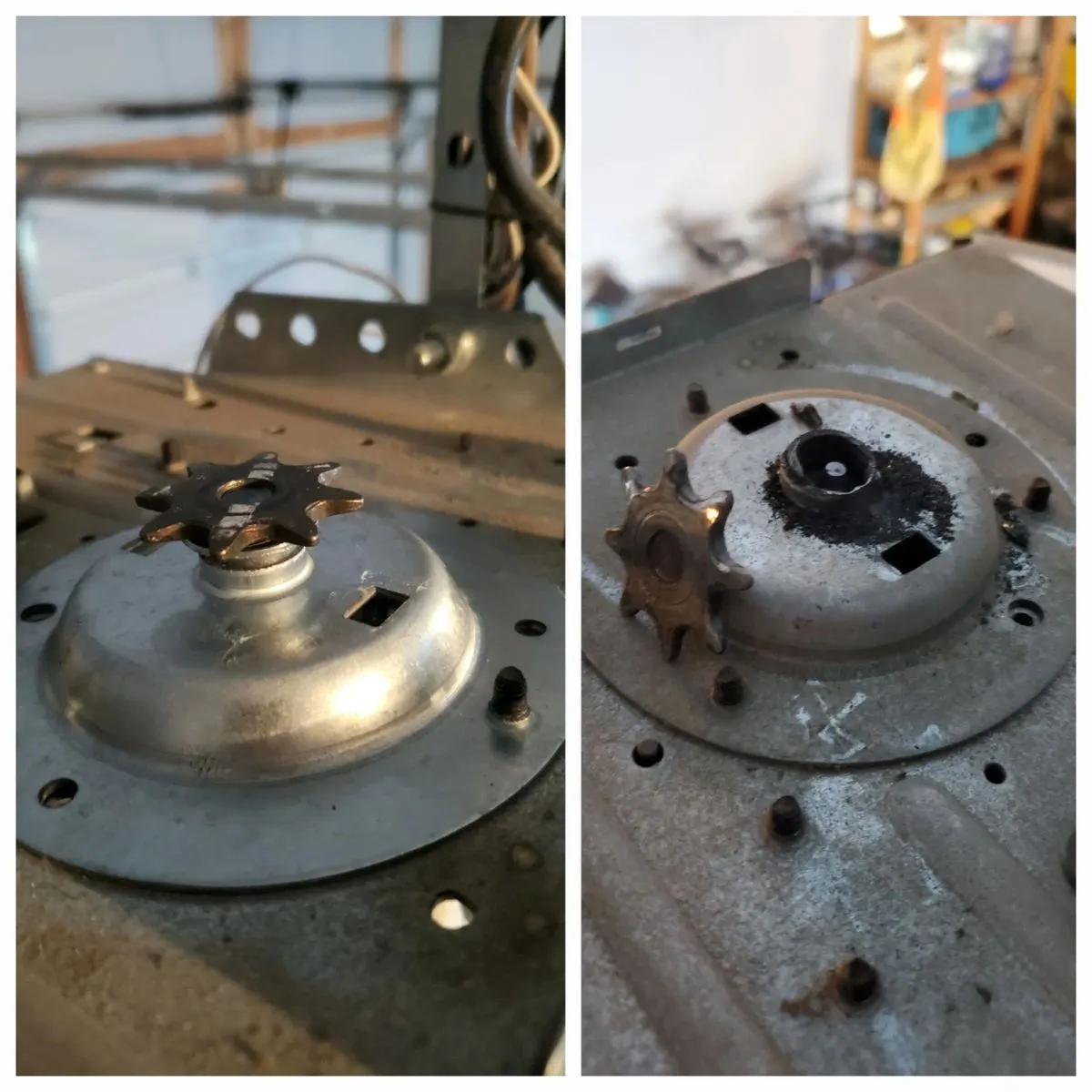
A typical residential opener is often in the 10- to 15-year range by the time parts start failing regularly. That is not a hard expiry date. A well-kept chain-drive unit can outlast that; a cheaper opener on a heavy door can start shedding gears sooner. Age matters most when boards or gears are discontinued, the housing or rail is damaged, the motor runs hot, the unit has no proper safety sensors, or you want a quiet belt, battery backup, or myQ the old unit cannot do cleanly. A five-year-old opener with a failed gear is usually a repair. A fifteen-year-old opener with a second board in three years is usually a replacement.
The parts we actually repair
Usually a repair
Worn drive gears, a failed logic board, safety sensors that are out of alignment or have a broken bracket, remotes and wall buttons, a stretched chain that just needs tightening, travel limits that have drifted, or a Wi-Fi module that has dropped off the network.
Usually a replacement
A burnt or seized motor, a cracked or rusted housing, a rail that is bent or coming off the ceiling, repeated board or gear failures on an old unit, or a model that no longer has parts. Wanting battery backup or a quiet belt on an opener that cannot take them is also a replace, not a retrofit.
Sensors deserve a special mention, because they mimic a “broken opener.” If the door goes down and then comes back up, or the lights blink and nothing moves, start with the photo eyes at the bottom of the tracks — dirty lenses, a bumped bracket, or sun in the lens late in the day. The won’t open or close guide covers those quick checks. If the sensors themselves are cracked or the wiring is shot, that is a straightforward opener repair in Kanata or wherever the house is, not a new motor.
When repair is the right call
Repair makes sense when the failure is one part, the rest of the unit is solid, and the part is still available. A humming opener with a worn gear is the classic example, as is a logic board that died after a surge, or sensors that will not stay aligned because a bracket rusted through. We carry common gears, boards, and sensors on the truck, so most of those visits are finished the same day. The quote is written before we start. If the motor or the rail is in worse shape than it looked, we stop and talk about replacement instead of adding parts to a unit that will not last.
Same-day opener repair in Barrhaven, Nepean, and Gloucester follows that same rule: fix what failed, and only replace the unit when that is the better repair.
When replacement makes more sense
Replacement is the cleaner path when the opener has had more than one significant repair in a short span, when parts are no longer made for that model, or when the next likely failure is the motor itself. It is also the better path when you want a quieter belt-drive, battery backup, or built-in myQ — retrofitting those onto an old chain-drive is often awkward and still leaves you with an old motor — or when the unit never had proper safety sensors. If you are already replacing a door, a new opener can be set up for the new weight in the same visit.
We install LiftMaster, Chamberlain, and other major brands, including chain-drive, belt-drive, and smart Wi-Fi models. A typical install is a one-visit job. For neighbourhood pages, see opener installation in Orleans or Stittsville, or the city-wide openers page.
Belt vs chain, briefly
Chain-drive is durable, a little noisier, and a solid choice for a detached garage or a space where quiet is less important. Belt-drive is the quieter option when a bedroom, office, or living room sits above or beside the garage. Both will lift a standard residential door when the unit is sized correctly. The longer comparison — including smart and battery-backup options — is in the best openers guide. We will recommend one after we see the door, not from a photo of the old motor alone.
myQ, Wi-Fi, and “the app stopped working”
A myQ or Wi-Fi opener that ignores the app is not always a failed opener. The home Wi-Fi may have changed, the module may need a reset, or the logic board may have dropped the connection. Those are often repairs or a short setup visit. It is a replacement conversation when the opener has no path to reliable smart control, or when you want the app and alerts and the unit on the ceiling cannot do it. We work on myQ-ready LiftMaster and Chamberlain openers, and we will tell you if an add-on on the current unit will actually be reliable.
Safety either way
Whether we repair or replace, the door has to reverse when it hits a reasonable obstruction, and the photo-eye sensors have to be aimed and working. Do not tape over a sensor, and do not disconnect it to “just get the door down.” If the door is closing on its own or will not reverse, unplug the opener and call. A new opener is also a chance to set the force and travel correctly for this door, not for the door that was here ten years ago. That adjustment is part of the install.
FAQ
Should I repair or replace my garage door opener?
Repair is usually the right call when one part has failed — a gear, a logic board, a sensor, or a remote — and the opener is otherwise solid, with parts still available. Replacement makes more sense when repairs keep coming back, the housing or motor is done, the unit is too old for parts or safety features, or you want a quieter belt drive, battery backup, or myQ.
How much does opener repair cost in Ottawa?
Opener repair is typically $150–$280 plus HST, parts and labour, with a 3-year warranty on the work. You get a written quote before we start. If replacement is the better path, we will say so rather than stack repairs.
How much does a new garage door opener cost in Ottawa?
A new opener installed is typically $650–$950 plus HST, depending on the model. Chain-drive starts from $700 plus HST. Belt-drive and smart Wi-Fi models fall inside the same overall range. Quoted on site after we confirm the door weight and the setup.
The opener hums but the door does not move. Is that a repair?
Often yes — a worn gear is a common cause. It can also be a broken spring, and the opener is stalling because it is trying to lift a door the springs should be carrying. Do not keep hitting the button. We check the springs first so we fix the right thing.
Can you add myQ or Wi-Fi to my old opener?
Sometimes, with a compatible add-on. Many older units are not a clean fit, or the motor and gear are already tired. In those cases a new myQ-ready opener is the more reliable path. We will tell you which one you actually have.
Not sure which way to go? We will tell you on site.
GDS repairs and installs garage door openers the same day across Ottawa, from 58 Larkspur Dr, Unit D, Nepean. Call or text 343-777-8893, book online, or request a quote. A photo of the opener and the spring shaft is enough for a first range over the phone.