
Why Garage Door Springs Break in Winter in Ottawa
If you have lived in Ottawa for more than a few winters, you already know the sound. A loud bang from the garage on a cold morning, then a door that will not lift, or that the opener can barely drag. That bang is almost always a broken torsion spring.
Cold does not snap a healthy spring by itself. A spring already near the end of its life meets a harder first cycle of the day. Here is why that is so common in Ottawa, the signs to watch for, and why a torsion spring is not a DIY job. For the repair, see garage door spring repair in Ottawa. For lubrication, seals, and a frozen door, use the winter maintenance guide.
If you already heard the bang: leave the door down if you can, unplug the opener, and call 343-777-8893. Do not pull the red release cord while the door is up, and do not keep hitting the wall button.
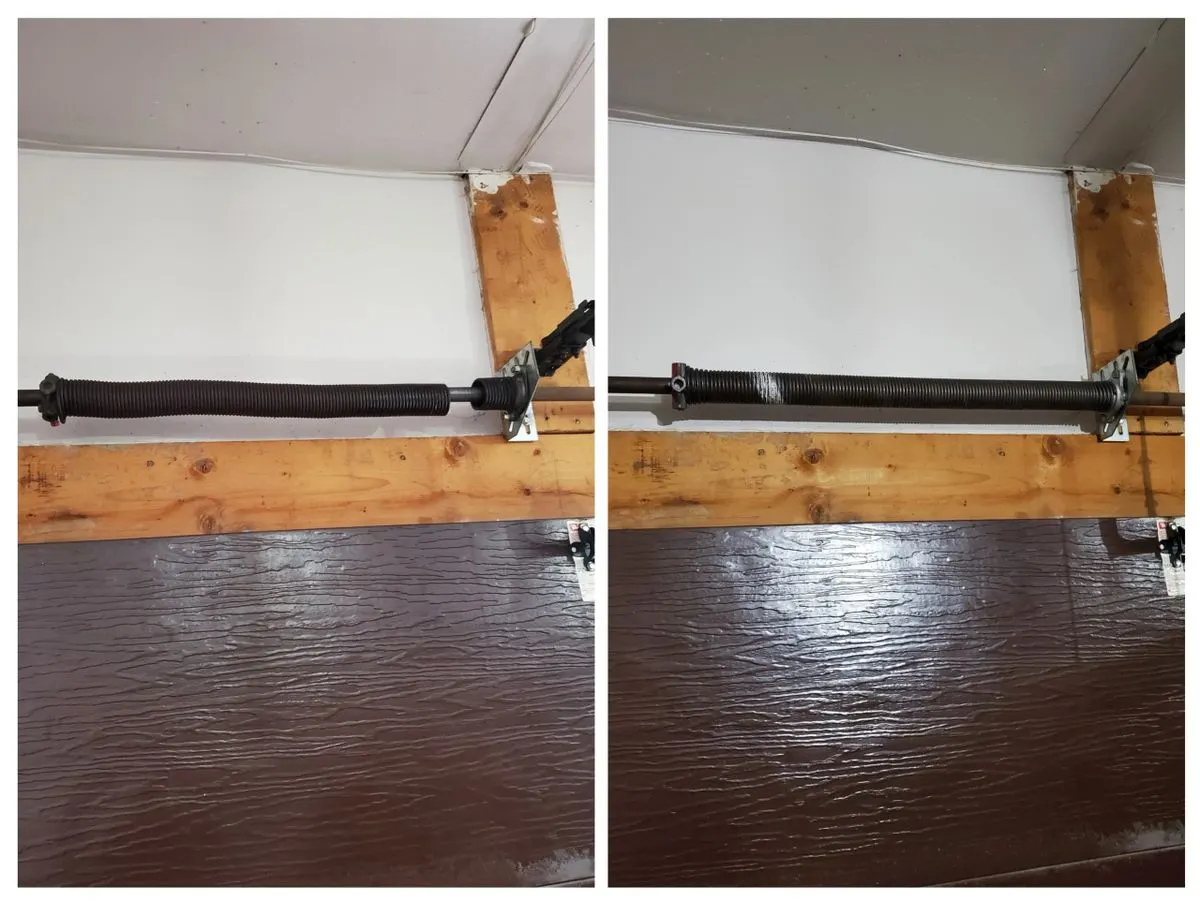
Why the first cold snap is hard on springs
A torsion spring sits on a shaft above the door opening. It winds and unwinds every time the door moves, and it carries the door’s weight — often 150–200 lb for a single, and 300–400 lb for a typical double. That is why the door feels light when the springs are healthy, and like a slab of concrete when one breaks.
On a hard Ottawa freeze, especially in an unheated garage, two things change. The steel is less forgiving: a coil that has already flexed through thousands of cycles has microscopic fatigue, and a tired spring is more likely to let go on a hard pull than on a mild October afternoon. The first cycle of the day is also heavier. Overnight, seals can stick to a frozen slab, rollers sit dry, and grease thickens, so the springs have to break the door free, not just lift it. That extra shock often finishes a spring that was already close.
We see this on calls for spring repair in Kanata, Barrhaven, Nepean, and Orleans after the first real cold week, and again during mid-winter snaps. A standard spring is commonly rated for 10,000 cycles — daily use plus a few Ottawa winters often puts it near that limit when the first deep freeze arrives.
It is usually fatigue, not “the cold broke it”
The story we hear is that the door was fine yesterday. That can be true. Springs rarely give a long warning. Every open-and-close is one cycle, and age, door weight, and balance all use up the rating. Winter is often just when the tired coil lets go. A door that is already out of balance makes the remaining spring and the opener work harder. Road salt is harder on cables than on the spring — if a cable is frayed or slack, see the cable warning-signs guide.
If you are not sure whether you have torsion or extension springs, this comparison shows how to tell from the floor. Most Ottawa doubles use torsion springs above the opening. Older singles sometimes still have extension springs along the tracks. Both can fail in the cold. Torsion springs are the ones that bang and show a visible gap in the coil.
Signs a spring is on its way out
Look from the floor with the door down, and notice how the door feels when you use it.
| What you notice | What it often means | What to do |
|---|---|---|
| The door feels heavy, or the opener is straining | The springs are tired, or one is already broken. | Stop using the opener. A motor is not a substitute for a spring. |
| A visible gap in the coil above the door | A torsion spring has broken. | Leave the door down and call. This is not a lubrication issue. |
| The door opens a few inches and drops, or will not stay up | The springs are no longer carrying the door. | Do not try to prop it or lift it by hand. |
| Rust, a stretched coil, or uneven gaps between coils | Wear and corrosion, common in unheated garages. | Book a replacement before the next hard freeze if you can. |
| A loud bang, then a crooked or stuck door | Spring, cable, or both. | See the emergency steps. Do not run the opener. |
A heavy door is the most useful everyday clue. If it used to lift easily and now feels much heavier, the springs are due. Call and describe what you see rather than disconnecting the opener to test it.
What to do if the spring already snapped
- Leave the door down if it is already down, so the garage stays secure and the door cannot drop.
- Unplug the opener so no one can run it from a remote or a keypad.
- Do not pull the red emergency release if the door is up. If the springs are not holding it, the door can come down hard.
- Do not try to wind the spring, loosen set screws, or put a winding bar or screwdriver in the cones.
- Call 343-777-8893. A photo of the spring shaft is enough for us to confirm it is a spring and give you a range before we arrive.
Same-day spring repair is the usual visit, including spring repair in Gloucester. We replace springs as a pair, because the second spring is the same age as the one that broke. What the visit looks like is in the spring replacement guide.
Why you should not DIY a torsion spring
Torsion springs are under high tension. People get hurt when a winding bar slips, when the wrong size spring is installed, or when the door drops. Hardware-store springs are often the wrong wire size or length for that door.
- Do not wind the spring, or loosen drums, cables, or set screws.
- Do not stand on a ladder at the shaft with a winding bar, a screwdriver, or vice-grips.
- Do not lift a crooked or stuck-open door back into place by hand or with the opener.
- Do not “just get it working” with the opener. It is not built to lift an unbalanced door, and forcing it can burn out the motor or strip the gear.
A correct replacement matches the spring to the door weight, winds it to the right turns, sets the cables, and tests the balance. That is a technician job, not a weekend project.
A few things that actually help before winter
You cannot stop a spring that has already used up its cycles. You can make the first cold morning easier on one that still has life left: lubricate the spring shaft and the hinges, and free a bottom seal stuck to the ice rather than forcing the opener. Those steps are in the Ottawa winter maintenance guide. A yearly tune-up is when we catch a rusty coil or a heavy door before the January bang. If the door is already heavy, book spring repair in Ottawa before it lets go.
FAQ
Why do garage door springs break in the winter?
A tired spring is more likely to fail on a cold first cycle, when seals stick, grease thickens, and the steel is less forgiving. The spring was usually already near the end of its cycle life. Cold is the trigger, not the only cause.
Can I replace a torsion spring myself?
No. Torsion springs are under high tension. Leave the winding cones, drums, and set screws alone and call a technician. Do not run the opener to lift a door with a broken spring.
Should both springs be replaced?
Yes. They are the same age and have seen the same cycles. Replacing one leaves the other ready to fail, often on the next cold morning.
How much does spring replacement cost in Ottawa?
Typically $250–$350 per spring, parts and labour, with a 3-year warranty. Most Ottawa doors use two springs. You get a written quote before work starts.
The opener is still running. Can I keep using the door?
No. The opener is trying to lift a door the springs should be carrying. You can burn out the motor or damage the door. Unplug it and call.
Heard a bang? Leave the door down.
GDS replaces garage door springs the same day across Ottawa, from 58 Larkspur Dr, Unit D, Nepean. Call or text 343-777-8893, book online, or request a quote. If the door is stuck open or off the track, start with the emergency steps.